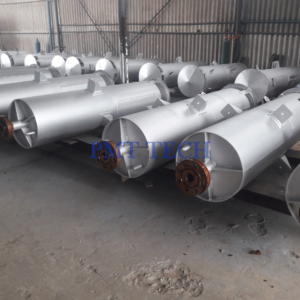
Gas Turbine Exhaust Silencer
Advanced Acoustic Attenuation System for Gas Turbine Exhaust Applications
Overview
Gas Turbine Exhaust Silencers are engineered to reduce the high-intensity aerodynamic and combustion noise generated by exhaust gases discharged from gas turbines through exhaust stacks and ducting systems. Gas turbine exhaust streams contain high-temperature, high-velocity gases that produce significant broadband noise across low, medium, and high-frequency ranges.
The exhaust silencer is designed to achieve effective acoustic attenuation while maintaining optimized gas flow characteristics, low pressure drop, and reliable operation under severe thermal conditions.
These silencers are widely used in power generation, cogeneration plants, petrochemical facilities, process industries, and turbine-driven mechanical systems.
Working Principle
High-temperature exhaust gases from the gas turbine enter the silencer assembly and pass through specially engineered acoustic flow passages.
The exhaust flow is guided through annular or split acoustic chambers containing high-temperature sound-absorbing media protected by perforated metallic liners. As the exhaust gases travel through the silencer:
- Acoustic energy is absorbed by the acoustic packing
- Turbulence-generated noise is attenuated
- Pressure pulsations are reduced
- Sound transmission through the exhaust stack is minimized
The internal aerodynamic design is optimized to ensure:
- Uniform gas distribution
- Minimal flow restriction
- Low system back pressure
- Stable thermal performance
Depending on project requirements, the silencer may incorporate:
- Absorptive attenuation sections
- Reactive acoustic chambers
- Hybrid acoustic configurations
Design Features
- Heavy-duty welded steel construction
- High-temperature resistant acoustic insulation media
- Perforated stainless steel acoustic liners
- Aerodynamically optimized internal flow passages
- Low pressure drop configuration
- High acoustic attenuation efficiency
- Corrosion and erosion resistant internal components
- Structural reinforcement for thermal expansion loads
- Suitable for horizontal or vertical installation
- Circular or rectangular execution
Engineering Design Parameters
Each silencer is custom engineered based on:
- Turbine exhaust flow rate
- Exhaust gas temperature
- Operating pressure
- Allowable pressure drop
- Required noise attenuation level
- Stack dimensions
- Installation orientation
- Environmental and operational conditions
Acoustic and thermal performance calculations are performed to ensure compliance with project-specific noise criteria and turbine operational limits.
Acoustic Packing System
The acoustic section incorporates specially selected high-temperature resistant acoustic media designed for continuous operation under elevated exhaust temperatures.
Acoustic packing features include:
- High thermal stability
- Excellent sound absorption properties
- Resistance to vibration and gas erosion
- Long operational life
Configurations available:
- Circular acoustic modules
- Rectangular acoustic splitters
- Customized acoustic panel arrangements
Applications
Gas Turbine Exhaust Silencers are widely used in:
- Gas Turbine Power Plants
- Combined Cycle Power Stations
- Cogeneration Facilities
- Petrochemical Plants
- Oil & Gas Installations
- Compressor Stations
- Industrial Turbine Exhaust Systems
- Offshore Platforms
- Mechanical Drive Turbines
Materials of Construction
Depending on operating conditions, silencers are manufactured using:
- Carbon Steel
- Stainless Steel
- High-Temperature Alloy Steel
- Weather-resistant external coatings
Internal components are selected for resistance to:
- Thermal fatigue
- Corrosion
- Vibration
- High-velocity gas erosion
Performance Advantages
- High exhaust noise attenuation performance
- Minimal turbine back pressure
- Robust construction for severe-duty operation
- Excellent thermal resistance
- Long maintenance-free service life
- Optimized aerodynamic performance
- Suitable for continuous high-temperature operation
- Custom-engineered acoustic solutions
Optional Configurations
- Stack-integrated silencers
- Weatherproof outdoor construction
- Thermal insulation cladding
- Expansion joint integration
- Access doors for inspection
- Spark arrestor arrangements
- Multi-stage acoustic systems
- Customized support structures